The play came to an end without even the curtain bell ringing
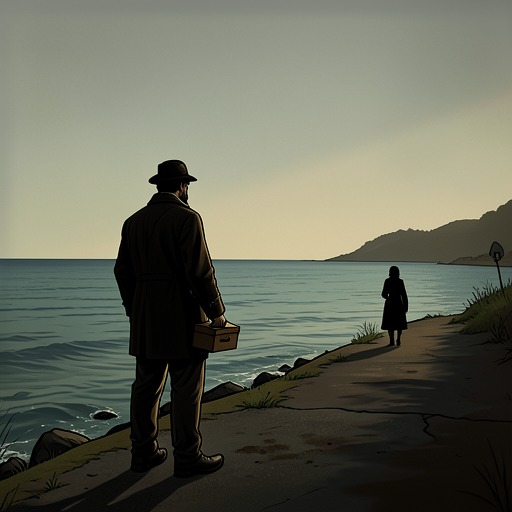
The Box ManThe play came to an end without even the curtain bell ringing is an expression of an ending that is both decisive and incomplete. Its theatrical image makes closure seem to have occurred before anyone can announce it, while the surrounding narration immediately unsettles that closure: the narrator claims not to regret failure, hears a door, and then corrects what that sound means. The phrase therefore marks not a clean finish but a threshold where an ending is declared, revised, and made ominously provisional.
Theatrical Closure Without Announcement
The expression appears in broken, emphatic lines: the play comes to an end, but the bell has not rung to signal the curtain. The lineation gives the declaration the quality of a staged finale, yet withholds the ordinary cue that would confirm it. The contradiction is central to its force. An ending has happened, but its customary public sign is absent; the conclusion must be inferred rather than witnessed through ceremony.
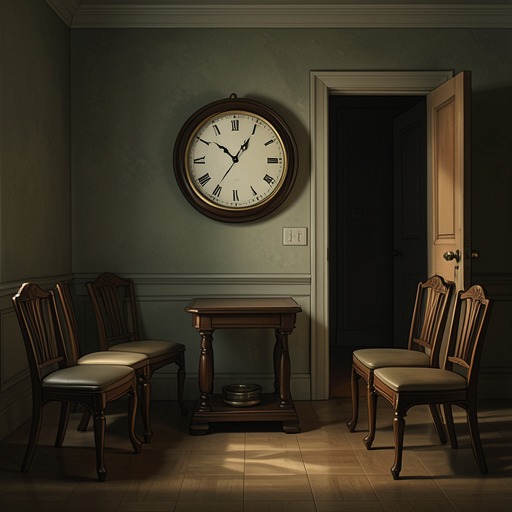
A later formulation places the image beside illusory time and clock hands standing vertically on the dial. Time seems suspended at the point when a performance should be announced as over. The play’s end and the clock’s arrested hands reinforce one another: both suggest a stoppage, but neither offers the reassuring precision of a completed, measurable interval. The bell that should separate performance from what follows remains silent, leaving the boundary uncertain.
Failure and the Refusal of Regret
The expression follows a passage in which the speaker describes trying to escape pain, seeking peace through the techniques of wooing, and cherishing a fiery wind that begins with lost love. The language enlarges romantic longing into an almost transformative force: the speaker imagines time stopping at a light touch and a physical change that will last until death. Against this heightened anticipation, the abrupt announcement that the play has ended sounds like a curtain falling on a promised emotional resolution before it can be secured.
The narrator then says that the failure was real but not a reason for regret, and that life had not been pursued for the sake of a conclusion. This qualification changes the theatrical metaphor. The end is not treated as the sole measure of what came before; the speaker claims that being wrong and failing are different things, and that failure does not invalidate the experience. At the same time, the insistence on not living for a conclusion makes the ending newly uncertain: the narrator rejects a final outcome as the purpose of life, even as the play image gives the scene the shape of a finale.
The Sound That Reopens the Ending
Immediately after the declaration of failure without regret, the narrator hears what seems to be the front door shutting. That sound could confirm departure and release, but the later confession retracts the interpretation. The narrator had actually heard the door to the woman’s room; the front door has been nailed shut from the beginning. The apparent final cue is thus not the sound of escape. What seemed to complete the scene instead exposes the narrator’s error and the limits of the ending just pronounced.
The correction makes the missing curtain bell more than a theatrical flourish. Without an authoritative signal, the narrator supplies an ending from a sound that has another source, then has to disclose the mistake. The narration itself performs the uncertainty expressed by the phrase: it announces closure, allows a moment in which that closure appears plausible, and then reveals circumstances that keep the situation active. The play may have ended as an image, but its consequences have not been resolved.
Confinement and the Unfinished Curtain
The narrator’s clarification establishes the physical terms of the scene. The front door is firmly closed, the emergency stairs are locked, and the woman must remain inside the building. The narrator focuses on her blouse and skirt as the remaining separation between them, then considers cutting off the electricity so that her clothes would no longer be visible. Darkness is imagined as equivalent to being with a blind man, under which she might become gentle again. These details turn the language of curtain and darkness into part of a coercive situation, not simply a graceful emblem of artistic closure.
The expression consequently holds two endings in tension. It registers the narrator’s sense that the romantic effort has failed and that no conclusion is owed, but it also precedes a confession that intensifies the woman’s confinement and the narrator’s fixation on removing the barrier of sight. The absent bell leaves no dependable division between a finished performance and continuing action. Its significance lies in that unstable pause: the ending is spoken, yet the door is not open, the woman is still inside, and the narrator’s final plan has not ceased to unfold.